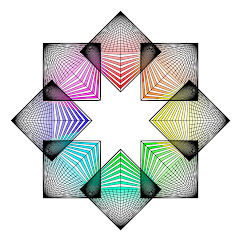
Andrés Gómez Emilsson presents a model using hyperbolic geometry and dynamical systems theory to explain the structure of DMT hallucinations.
Andrés Gómez Emilsson from the Qualia Research Institute (qri.org) presents about the Hyperbolic Geometry of DMT Experiences.
At a high-level, this video presents an algorithmic reduction of DMT phenomenology which imports concepts from hyperbolic geometry and dynamic systems theory in order to explain the "weirder than weird" hallucinations one can have on this drug. Andrés describes what different levels of DMT intoxication feel like in light of a model in which experience has both variable geometric curvature and information content. The benefit of this model cashes out in a novel approach to design DMT experiences in order to maximize specific desired benefits.
See original article: qualiacomputing.com/2016/12/12/the-hyperbolic-geometry-of-dm…
And the ELI5 version: qualiacomputing.com/2017/05/28/eli5-the-hyperbolic-geometry-…
Presentation outline:
Thermometers of Experience
The Leaf Metaphor
Introduction to Hyperbolic Geometry
DMT Levels
Level 1: Threshold (& Symmetry Hotel)
Level 2: Chrysanthemum
Level 3: Magic Eye (& Crystal Worlds)
Level 4: Waiting Room
Level 5: Breakthrough
Level 6: Amnesia
Energy - Complexity Landscape
Dynamic Systems
Fixed Point
Limit Cycles
Chaos
Noise Driven Structures
Turbulence
Conclusion
Super-Shulgin Academy
Atman Retreat
Wrap-Up
About the speaker: Andrés studied Symbolic Systems at Stanford (and has a masters in Computational Psychology, also from Stanford). He has professional experience in data science engineering, machine learning, and affective science. His research at the Qualia Research Institute ranges from algorithm design, to psychedelic theory, to neurotechnology development, to mapping and studying the computational properties of consciousness. Andrés blogs at qualiacomputing.com.
The Qualia Research Institute (QRI) is a non-profit based in the Bay Area close to San Francisco which seeks to discover the computational properties of experience. QRI has a "full-stack approach" to the science of consciousness which incorporates philosophy of mind, neuroscience, and neurotechnology. For more information see: qualiaresearchinstitute.org
The Harvard Science of Psychedelics Club hosts events on psychedelic research, meditation, neuroscience, students sharing their own experiences, and much more.
Credits:
- Wallpaper group 632 rotating along each symmetry element - Nick Xu
- Many of the images are by Paul Nylander: bugman123.com/
- The Hyperbolic Honeycomb images and 3D prints are by Henry Segerman, who also has an awesome Youtube channel where he shows 3D printed math. We used his design to print the Honeycombs we were passing around during the lecture: youtube.com/user/henryseg
- Space-Time Dynamics in Video Feedback: Jim Crutchfield, Entropy Productions, Santa Cruz (1984): youtu.be/B4Kn3djJMCE
Many thanks to Andrew Zuckerman and Kenneth Shinozuka for helping organize this event. And thanks to David Pearce, Mi
Why it's here
3 people recommend this
What people say. Recommended as an intriguing mathematical and phenomenological analysis of the visual and spatial structure of DMT experiences.
n
nabla9in Hacker News • Recommends
On “LSD and psilocybin increase the fractal dimension of brain activity”
Here is interesting study lecture and article, maybe somewhat related. The Geometry and objects of things you see in typical to DMT experiences are hyperbolic. Lecture link to this video The Hyperbolic Geometry of DMT Experiences: Symmetries, Sheets, and Saddled Scenes link
On “How to create a game using hyperbolic geometry?”
You’re adding another dimension. Sort of a “half” dimension. If you want a distance function in a space that’s non-Euclidean, you’re likely (always?) going to have something you can represent as hyperbolic geometry. Check out metric spaces and measures on Wikipedia. For a “vibes” intro, The Hyperbolic Geometry of DMT experiences has a good intro in the beginning. link to this video I’m no expert on hyperbolic geometry. These things just helped me “get it” in the sense of “I get why that’s a thing”. Also, seeing it for yourself doesn’t hurt.
On “The Hyperbolic Geometry of DMT Experiences (2016)”
Hello! I'm the author of this article. I stand by it and I think comments are failing to engaging with the actual models, phenomenological observations, and synthesis provided. I suspect people here have not actually payed attention to these experiences and may have epistemological assumptions that make them think it's impossible to bring useful information back. In particular, I'll say that the article's analysis assumes indirect realism about perception (it's all "in your head"), it focuses on structural features of the experience (phenomenal character rather than intentional content - I'm not interested in what the machine elves told you, I'm interested in what were the wallpaper symmetry…